
The Power of Photography on Display in the Home
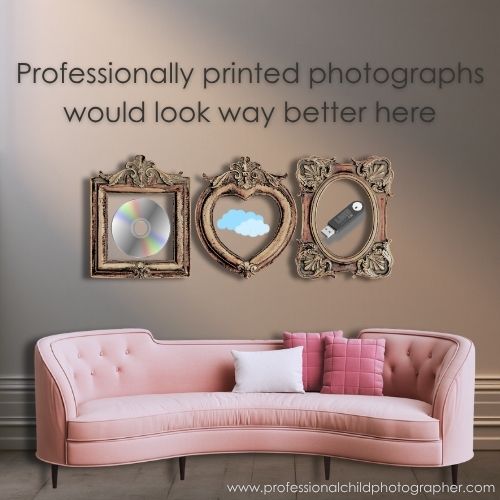
What we know about child development and the topic of displayed family photos:
• Studies consistently show that visual reminders of family connection boost children’s sense of security
• Dr. David Krauss (a child psychologist) has extensively written about how family photos help children understand their place in the family narrative
• Research from UCLA shows that children who grow up in homes with family photos displayed have stronger family bonds
When hiring a professional photographer it’s imperative to understand their services and why they offer what they offer
Professional photography has evolved dramatically with one truth remaining: printed photographs outlast digital files in both quality and emotional impact. While (literally) everyone you encounter takes photos on the daily, there’s currently a growing movement back toward investing in tangible, professional prints that transform houses into homes and preserve memories for generations.
The Digital Dilemma: What Really Happens to Those Files
When you hire a professional photographer, you’re investing in capturing your family’s story. Yet many clients still believe getting digital files is the best value because they can “print them later” and “control the process.”
Here’s what actually happens: those files rarely get printed. They sit inside a computer on the hard drive, they get shoved inside a drawer “for later” usage when stored on USB keys, they get filed away somewhere in the cloud, the images may be viewed occasionally on screens with other carouseled images that run from casual snapshot to professional photograph. Not one of those options allows for display proudly in a home where they can be appreciated daily.
Why Digital Storage Fails
Technology becomes obsolete faster than ever. Consider this timeline:
- Floppy disks: Standard in the 1990s, obsolete by 2005
- CD-ROMs: Popular through the 2000s, now many computers don’t have drives, CD-ROM or DVD
- USB drives: Current standard, but already being replaced by cloud storage; also the old USB-A format is quickly being replaced by USB-C
- Hard drives: Fail regularly, with average lifespans of 3-5 years
Real scenarios that happen regularly:
- USB drives become corrupted or unreadable
- Hard drives crash without warning
- Cloud storage accounts get deleted or companies shut down
- File formats become incompatible with newer software
- Equipment gets stolen, damaged, or lost
We Are Experiencing a Print Renaissance
There’s growing demand for professionally printed photography. The global wall art market, which includes photography among other decorative pieces, was valued at $56.2 billion in 2023 and is projected to reach $94.8 billion by 2033, according to Future Market Insights. Professionally printed photography – displayed as standalone wall art or in curated gallery arrangements -is a key driver of this growth.
Clients are choosing professionally printed photographic art – here are the reasons why:
| Why Professionally Printed Photography Matters | |
|---|---|
| Lasting Impact | Unlike digital files, so-very-often-forgotten on digital storage mediums and devices – displayed wall art serves as daily reminders of treasured moments. |
| Home Enhancement | Professional prints transform living spaces into personalized art galleries reflecting your family’s story. Beautifully executed photographs are often your best friend to personalize your home decor and gives you a sense of direction for your decor (or vice versa: you may wish to dress your family to an already-designed space to match the room, so to speak). |
| Quality & Longevity | Professional labs calibrate their equipment with regularity and use archival materials that maintain vibrancy for generations, unlike consumer prints that are likely to fade. Your photographer may also choose to have their prints sprayed with materials that prevent the absorption of UV rays by the photograph thus reducing the likelihood of fading or UV damage. |
| Emotional Connection | Seeing printed family photographs regularly deepens the connection to memories they represent for every family member. Children who see themselves represented in a portrait alongside their family have positively reinforced self-esteem and sense of belonging |
| Gift Value | Professionally printed images make wonderful, meaningful gifts that will be cherished long after that knick knack gets put away in a drawer somewhere. In other words: professionally printed images will stand the test of time as gifts for loved ones like special aunts or grandparents. |
Professional Quality vs. Consumer Printing
Your photographer controls every aspect of image quality : from the moment of capture to presenting you with your final prints. Professional photographers often partner up with professional labs that use archival papers, precise color calibration, and quality control that consumer printing simply cannot match.

What Professional Printing Delivers
- Color accuracy that matches your photographer’s artistic vision
- Archival-quality materials that won’t fade or deteriorate
- Quality control where imperfect prints are rejected and reprinted
- Professional consultation on sizing, framing, and display options
- Guaranteed results backed by the photographer’s reputation
Consumer printing limitations:
- Inconsistent color reproduction
- Lower-quality papers and inks
- No quality control or reprints
- Generic sizing options
- No professional guidance
Quality Over Quantity: The Professional Difference – Professional Prints vs. Digital
The difference between “I love them all!” as a goal vs. “SPRAY & PRAY”

The question shouldn’t be “How many images do I get?” but rather “How much will I love displaying these images in my home and showing them off to all my friends and family who come to visit?”
A hand picked, quality and experienced professional photographer is confident enough in their work to guarantee you’ll love every ordered and delivered image. They understand that their reputation depends on the quality of work hanging on your walls: from the moment of capture until the moment that print goes on display in your home…and for years after!
Amateur photographers (some who may call themselves professional) may often compensate for inconsistent quality by delivering large quantities, hoping some images will work out and be pleasing to their customer. The method is often called “SPRAY AND PRAY” by more experienced photographers that recognize this phenomenon all too well.
Making a Smart Investment
While digital files aren’t inherently bad, there are so many reasons to love access to digital images. As you know they’re perfect for sharing on social media and for creating holiday cards and graduation announcements. However, basing your photographer choice primarily on digital file availability may lead to disappointment simply because you may feel you are settling based on factors that do not include quality of artistry, technical know how and image quality.
Consider this approach:
• Investment in professionally prints: crafted by a partnership between your professional photographer and their most trusted photography printing labs for your most important images.
• Requesting web-sized/social media sized digital files as an add-on for sharing purposes online and via email
• If you do order strictly digital imagery make sure to read through any paperwork your photographer gives you regarding reprints and most of all trust any recommendations (lab recommendations, print up-to sizing and printing expertise) listed within that documentation for best results.

For Families:
Looking to evaluate a photographer for hire? Start here:
• What is Custom Photography?
• Why Choose Custom Photography?
• Questions to Ask Your Photographer [there is a pdf download for you print up at this link]
• Photographer Evaluation Checklist
Found this helpful?
You’re welcome to use any portion of this site on your blog, website, or social media pages!
Please credit any excerpts you use on your site or blog by copying and pasting the following on your site or social media page (with appropriate links enabled):
” This article was written by Marianne Drenthe of Marmalade Photography
www.marmaladephotography.com
and can be found at the Professional Child Photography site at
www.professionalchildphotographer.com ”
This article has been updated in 2025
In response to evolving industry practices and discussions with fellow photographers this update aims to clarify and enhance PCP’s insights into the choices consumers face in the current market along with costs and value of custom photography.
PCP’s goal is and always has been to provide timeless and accurate information for families in choosing the right photographer to capture their cherished moments.
If you would like to access a copy of the older article that appeared on our site please click: DIGITAL FILES VS. PRINTS